
Has Aisin Partnered with Smart Eye for Future DMS Developments?
Based on current information, the conclusion is yes.

Details published in a news release dated May 26 from Green Hills Software (GHS) could imply Aisin Corporation has ceased in-house development of driver monitoring software, and has partnered with Smart Eye for its next-generation product. Aisin was one of the first tier-1s to develop a DMS, and has supplied a simple vision-based steering-column mounted system to Toyota and Lexus for several years.
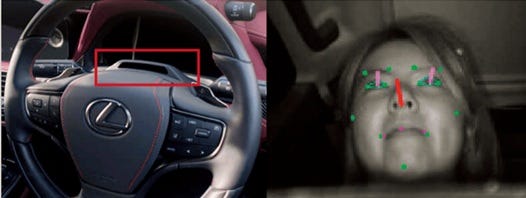
Source: Aisin
The news release itself is somewhat unconventional in the DMS world in that a consortium of software and component suppliers - GHS, NXP and Smart Eye - appear to have jointly released details of the next-generation DMS platform that Aisin is developing.
Absent is a formal news announcement from Aisin itself, any quote from Aisin’s senior management describing the new platform, or any response received to a request for comment that I submitted to Aisin.
GHS and NXP are very experienced PR operators and both are reliable sources of information, but it remains important not to draw too many firm conclusions until specifics are known.
However, the most obvious takeaway from the announcement would be that Aisin has bowed to the inevitable and ceased investment into its in-house driver monitoring software and outsourced future development to Smart Eye.
The release identifies the obvious frontier beyond distraction and drowsiness detection for DMS award nomination: OEMs are now actively seeking impaired driving detection.
Aisin names its new system “DADS”, or Driver Monitoring System with Alcohol Detection System, which is not to be confused with the very similarly named industry consortium “DADSS,” (Driver Alcohol Detection System for Safety) which uses spectroscopy via breath and touch detection rather than image-based analysis.
To date, only Smart Eye and Seeing Machines has publicly declared a capability to detect alcohol impairment using image-based behavioral analysis. Frankly, we can ignore casual press announcements of impaired driving detection from every algorithm developer and look instead to scientific evidence presented in peer-reviewed research.
To be blunt, scientific evidence is what NHTSA will base its eventual impaired driving rule making on, and that is where all DMS developers must make their case for competency in this area.
A second obvious takeaway from the announcement is that Aisin has selected NXP as the processor supplier for its new DMS. Notable is that NXP’s i.MX9 MPU runs the NXP eIQ neural processing unit (NPU) for AI processing, combined with Arm Cortex-A55 and Cortex-M7 cores for general and safety processing.
This reinforces the conclusion that driver and occupant monitoring is not positioned to universally adopt central-compute domain controllers supplied by the likes of Mobileye, Nvidia and Qualcomm. OEMs must also be looking at opportunities for edge-AI zonal controllers based on processors from suppliers such as AMD, Renesas, and Texas Instruments, as well as NXP.
Let’s look also at the DMS supply chain in Japan.