

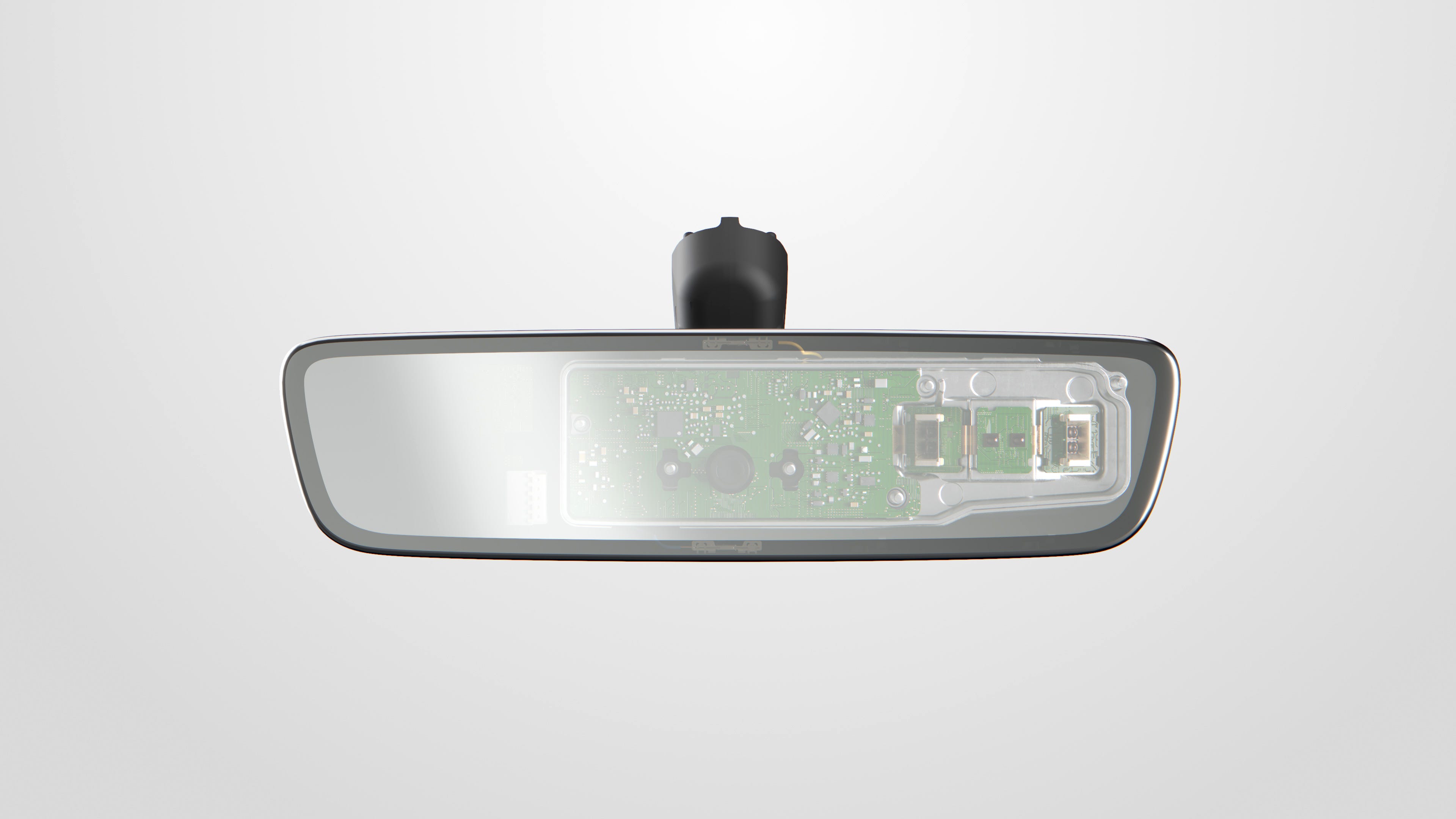
Magna has announced a new program win for its mirror-integrated driver and occupant monitoring system. The release describes the win “as a foundational, platform-level solution for [the] OEM,” which could be interpreted as saying Magna has won the OEM’s entire model range.
Also of note is the specific mention of both driver (DMS) and occupant (OMS) monitoring included in the win, suggesting this is an OEM either getting in-line with NCAP 26 point scoring for occupant monitoring, or already getting prepared for the NCAP 29 roadmap which will likely score DMS/OMS signals used for both ADAS integration as well as for advanced airbag deployment.
Either way, it implies the trend towards full-cabin sensing (away from basic driver monitoring) is now firmly underway. We should expect more wins announced during 2026.
The announcement further states: “The program marks a significant expansion of Magna’s DMS/OMS across global vehicle platforms and positions the company’s mirror-integrated system as a foundational element within next-generation vehicle architectures.”
This clearly implies the customer is a European global supplier and could be interpreted to mean the OEM is seeking to harmonize its cabin monitoring and advanced active safety strategies onto a single platform-level solution.
While an electronic DMS/OMS mirror is not itself cheap, a single solution to provide driver and occupant monitoring for both ADAS and airbag deployment offers cost savings through economies of scale — not forgetting the obvious opportunity to remove seat-mounted pressure sensors for advanced airbag control.
This is likely to be what Matteo Del Sorbo, President Magna Mechatronics, Mirrors and Lighting, means with the statement: “This award reflects a growing shift in how driver monitoring is being deployed at scale — not as a standalone feature, but as part of an integrated vehicle architecture.”
Magna very clearly highlights the fundamental benefit of mirror-based DMS/OMS: the integration of new functions without redesigning the cockpit or introducing additional hardware.
Magna tells us its offering is a fully-packaged product, integrating into a single embodiment: sensing (CMOS image sensor); illumination (940 nm optical path); electronics (vision processing); and software (DMS/OMS algorithms).
Magna’s strategy therefore looks to turn the software-defined architecture and central domain controller orthodoxy on its head.
The accepted SDV narrative suggests the integration of the DMS/OMS algorithms onto an ADAS domain controller (e.g. Mobileye, Nvidia, Qualcomm, etc.). But this leaves the OEM to figure out redesigning the cockpit to introduce the additional hardware (image sensor, IR illumination, cabling, housing etc.)
For “redesigning” read “extra costs.”
Magna’s solution seems to turn the whole argument around. It offers a fully-packaged and fully-tested DMS/OMS mirror which resolves all of the integration challenges, and simply outputs the driver and occupant state signals onto a (probably dedicated) communications bus linked to the airbag ECU and central ADAS domain controller.
Eh voilà! Fully-packaged driver and cabin monitoring, with the DMS/OMS signals routed to both the airbag and ADAS controllers.
The automotive industry already has a name for this: A zonal controller. I’ll just call it really clever problem solving.
Let’s go on to look at the possible identity of the European OEM in question.