
Seeing Machines wins two new Japanese OEM programs
Guessing the names of the OEMs is the least interesting part of the announcement.

Seeing Machines has today (June 15) declared two Japanese OEM program wins for its driver and occupant monitoring technology. From the outside we never know for sure who the customers are, but I would guess any two from: Honda, Mazda, Mitsubishi Motors, and Nissan. There isn’t enough information to be sure, but I don’t think either win is with Toyota (inc. Lexus) while Subaru seemed to nominate last year.
I often get asked how I go about digging into a program award like this. So let’s do some of the basics together.
First off, the process is entirely analog. Here is a screenshot of my actual printout and what I highlighted that stood out for me.
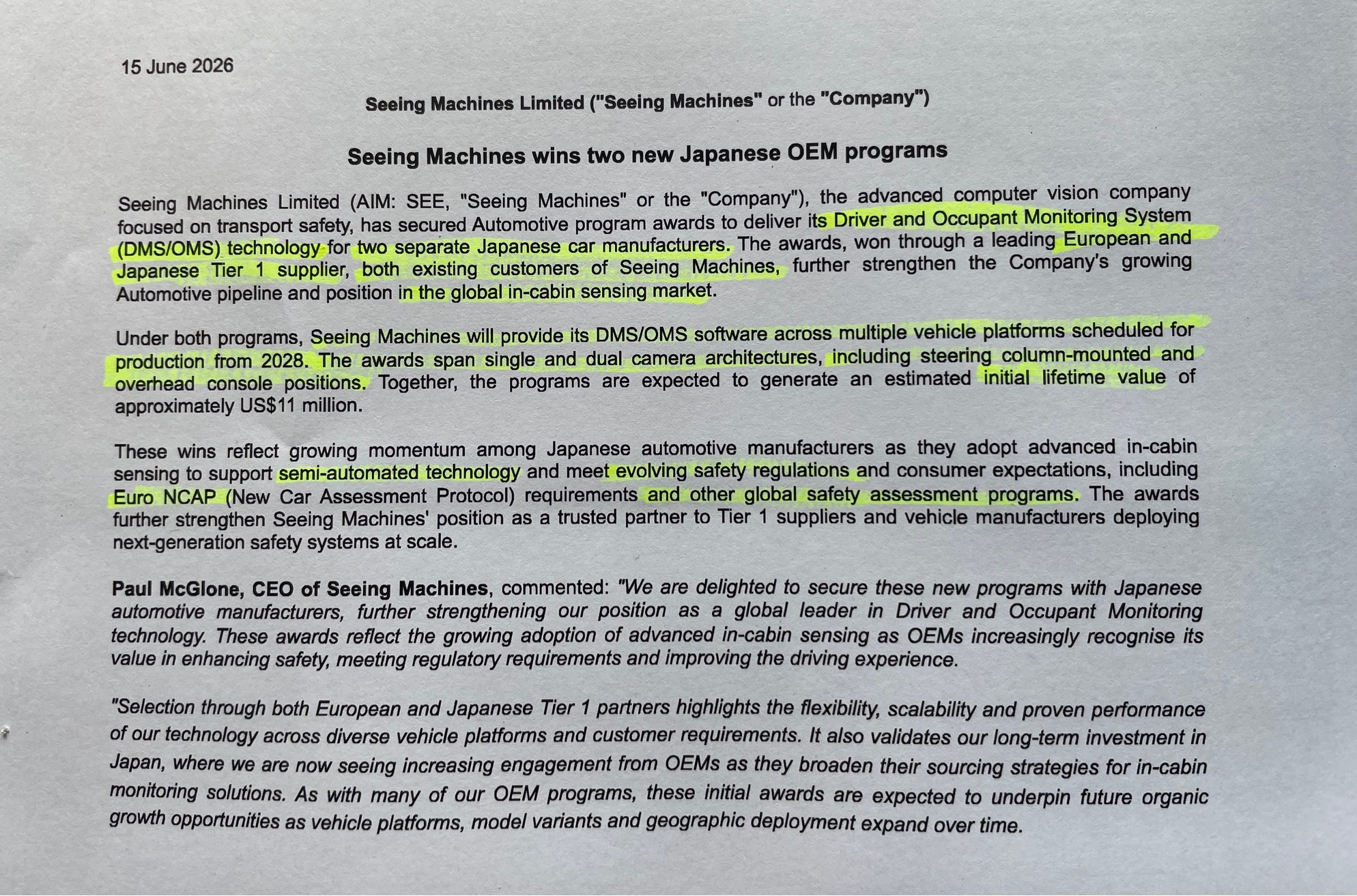
I read the words carefully several times, looking at and highlighting the specific language used for clues to what to pay attention to. I’m also always looking for what is missing or what is not said.
Over time it is these clues which come together to tell the narrative and point to market directions. This isn’t magic, it takes time, effort and attention - which are all sorely lacking in a world of LLMs and prompts to “tell me the answer in twenty words.”
Research and analysis just doesn’t work like that. Neither does life, but that is another story…
This is the AI summary provided by the link above:
“Seeing Machines Limited has secured two new Japanese OEM programs for its Driver and Occupant Monitoring System technology, expected to generate an initial lifetime value of approximately US$11 million. These awards, facilitated through existing Tier 1 supplier customers, will see Seeing Machines provide its software across multiple vehicle platforms scheduled for production from 2028, encompassing single and dual camera architectures. The company highlights these wins as a reflection of growing momentum in the Japanese automotive market for advanced in-cabin sensing to meet evolving safety regulations and consumer expectations, further strengthening its position in the global market.”
For sure AI picks out many key facts, but misses the nuance of the bigger picture that is created by putting this announcement alongside many others.
These are my highlights:
The win includes both driver and occupant monitoring.
It is for two separate Japanese car manufacturers.
Leading European and Japanese Tier 1 suppliers, both existing customers.
Multiple vehicle platforms scheduled for production from 2028.
Single and dual camera architectures, including steering column-mounted and overhead console positions.
Semi-automated technology and evolving safety regulations, including Euro NCAP and other global safety assessment programs.
My brief summary reads:
“The automotive DMS and OMS supply chain is inching towards consolidation around Seeing Machines and Smart Eye. Following nominations in Europe for GSR and NCAP, Japanese OEMs (J-OEMs) are next to show their acceptance of the critical role of DMS and OMS to enable both safe semi-automated driving and regulatory compliance. J-OEMs could already be showing a preference for incumbent tier 1 and tier 2 suppliers with proven DMS production expertise. Early evidence suggests a preference towards cameras in steering column and overhead console positions, spanning both single and dual camera architectures.”
Subscribers can read my more detailed analysis below.